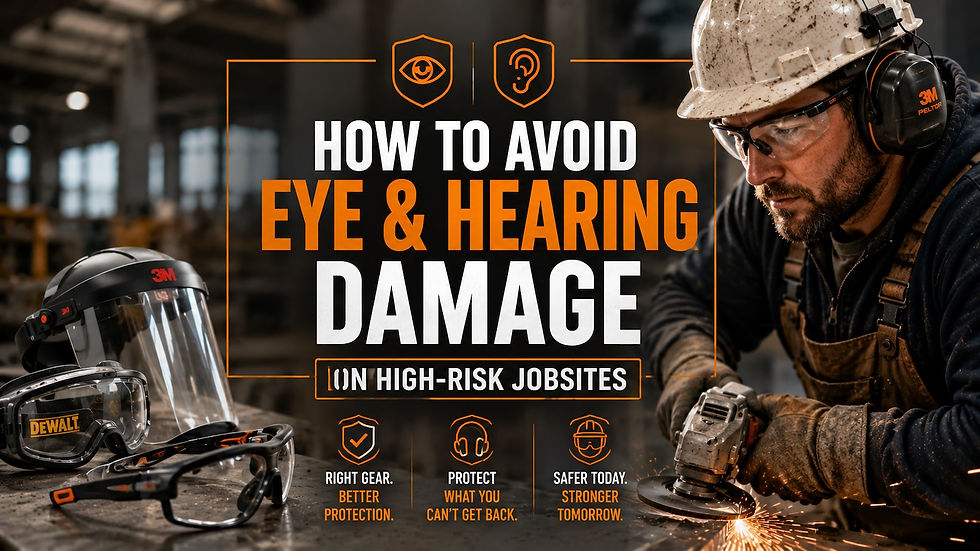
How to Avoid Eye and Hearing Damage on High-Risk Job sites
Start Here...
Flying debris and excessive noise are two of the most common workplace hazards, yet they're often treated as unavoidable parts of the job. A quick cut with a grinder, a few hours operating heavy equipment, or a day spent around impact tools can expose your eyes and hearing to damage that may be permanent.
The encouraging news is that most of these injuries are preventable. Choosing the right eye and hearing protection for the work you're performing doesn't just improve comfort—it helps protect your vision, preserve your hearing, and supports compliance with workplace safety requirements.
If you're not completely confident that your current protective equipment matches the hazards you face every day, this guide will help you build a smarter protection system.
Ask Yourself These Questions...
Are you wearing the same safety glasses regardless of the task you're performing?
Do your safety glasses constantly fog up or become scratched, making you less likely to wear them?
Are you exposed to loud equipment, impact tools, compressors, or machinery for extended periods?
Do you remove your hearing protection because it's uncomfortable or interferes with communication?
Have you ever experienced ringing ears, temporary hearing loss, or eye irritation after a day on the job?
If you answered "yes" to any of these questions, your eye and hearing protection system may need an upgrade.
Introduction
Most workplace injuries happen during routine tasks.
Workers become familiar with equipment, develop comfortable habits, and gradually stop noticing hazards that are present every day. Unfortunately, your eyes and hearing don't become more resistant simply because you've grown accustomed to the environment.
A single piece of flying metal can permanently damage your eyesight. Likewise, hearing loss often develops so gradually that many workers don't recognize the problem until it has become irreversible.
The goal isn't simply to own safety glasses or earmuffs. The goal is to select protective equipment designed specifically for the hazards of your job while remaining comfortable enough that you'll actually wear it throughout the workday.
At Bastian Operational, we believe protective equipment should never be selected based solely on price. The right safety glasses, face shields, and hearing protection become part of a complete workplace safety system that helps reduce injuries while supporting long-term productivity.
Quick Answer
The best way to avoid eye and hearing injuries is to match your protective equipment to the specific hazards of the job. ANSI-rated eye protection, properly selected hearing protection, and face shields when appropriate provide significantly greater protection than relying on basic safety glasses or disposable earplugs alone.
Products Discussed in This Article
Why Eye and Hearing Injuries Are Often Preventable
Unlike many workplace hazards, eye and hearing injuries usually don't happen because protective equipment doesn't exist.
They happen because the equipment being used isn't appropriate for the task—or isn't being worn consistently.
For example, standard safety glasses may provide adequate impact protection during general shop work but offer little defense against fine airborne debris entering from the sides. Likewise, workers frequently choose hearing protection based on comfort alone without considering the actual noise levels they're exposed to.
Another common issue is combining protective equipment that doesn't work well together. Safety glasses that interfere with earmuff seals or bulky hearing protection that pushes eyewear out of position can reduce the effectiveness of both.
Building an effective protection system means thinking about how each piece of equipment works together instead of evaluating every item individually.
At Bastian Operational, we believe comfortable protective equipment is safer protective equipment because workers are far more likely to wear it consistently throughout the day.
Solution 1: Choose Eye Protection Based on the Hazard—Not Just the Jobsite
Many workers own a single pair of safety glasses and wear them for every task.
While that's certainly better than having no eye protection at all, it's rarely the best solution.
Different jobs create different hazards, and your eye protection should reflect those differences.
ANSI-Rated Safety Glasses
For general construction, maintenance, manufacturing, and workshop environments, ANSI Z87.1-rated safety glasses should be your starting point.
One model that consistently performs well is the 3M SecureFit SF400 Series Safety Glasses. Their lightweight design, pressure-diffusion temples, and anti-fog lenses make them comfortable enough for extended wear, which encourages workers to keep them on throughout the day instead of removing them because of discomfort.
Look for features such as:
Anti-fog lenses
Scratch-resistant coatings
Wraparound side protection
Lightweight construction
Comfortable nose pads
Comfort matters because PPE only protects you when you're actually wearing it.
Sealed Safety Goggles
Some jobs require more than standard safety glasses.
Concrete cutting, demolition, insulation work, and heavy sanding often generate airborne particles that can bypass traditional eyewear.
The DEWALT DPG82 Concealer Safety Goggles are a good example of sealed eye protection that provides a much tighter barrier against dust while remaining comfortable enough for extended use.
They're especially well suited for:
Masonry
Concrete cutting
Wood sanding
Demolition
Dust-heavy manufacturing
Solution 2: Protect Your Entire Face During High-Impact Tasks
Grinding wheels, cut-off saws, wire brushes, and other high-speed tools create hazards that extend well beyond your eyes.
In these situations, adding a face shield provides another layer of protection.
The 3M Clear Polycarbonate Face Shield (WP96 Series) offers excellent impact protection against larger flying debris while maintaining clear visibility.
Remember that face shields supplement—rather than replace—ANSI-rated eye protection.
Workers performing welding or fabrication should also consider a quality welding helmet such as the Lincoln Electric Viking 3350 Auto-Darkening Welding Helmet, which is widely respected for its excellent optical clarity, dependable protection, and comfortable all-day fit.
Solution 3: Don't Wait Until Your Hearing Changes
Unlike many eye injuries, hearing damage develops gradually.
By the time most workers notice a problem, permanent damage has often already occurred.
Protecting your hearing every day is far easier than trying to compensate for hearing loss later.
Electronic Hearing Protection
Modern electronic hearing protection has dramatically improved over the past several years.
The ISOtunes PRO 3.0 Bluetooth Hearing Protection reduces hazardous noise while still allowing conversations, alarms, and important workplace sounds to remain audible. That balance between protection and communication helps improve both safety and long-term compliance because workers are less tempted to remove their hearing protection.
Traditional Industrial Earmuffs
For consistently loud industrial environments, the 3M PELTOR X5 Over-the-Head Earmuffs remain one of the highest-rated passive hearing protection options available. Their high Noise Reduction Rating makes them well suited for manufacturing, heavy equipment operation, and fabrication shops.
Workers looking for a lighter-weight alternative often choose the Honeywell Howard Leight VeriShield VS130 Earmuffs, which provide excellent protection while remaining comfortable during extended shifts.
For shorter-duration tasks or visitors who only need temporary protection, Howard Leight Laser Lite Disposable Earplugs continue to be one of the industry's most popular disposable options because they're comfortable, inexpensive, and easy to distribute.
At Bastian Operational, we believe hearing protection should be selected with the same care as every other piece of PPE. Equipment that's comfortable, compatible with the rest of your safety gear, and appropriate for the hazard is far more likely to be worn consistently.
Solution 4: Build a PPE System That Works Together
One of the biggest mistakes workers make isn't buying poor-quality PPE—it's buying individual pieces that don't work well together.
Safety glasses that break the seal on earmuffs reduce hearing protection.
Bulky earmuffs can push safety glasses out of position.
Face shields that don't fit over respirators or hard hats often end up sitting in the truck instead of being worn.
The best PPE is a complete system where every component complements the others.
For example, the lightweight temples on the 3M SecureFit SF400 Series Safety Glasses pair exceptionally well with both the 3M PELTOR X5 Over-the-Head Earmuffs and the Honeywell Howard Leight VeriShield VS130 Earmuffs because they minimize gaps in the earmuff cushions while remaining comfortable throughout the day.
Likewise, the 3M Clear Polycarbonate Face Shield (WP96 Series) is designed to work with safety glasses underneath, creating layered protection against flying debris during grinding, cutting, and fabrication.
When PPE works together, workers are far more likely to wear every piece consistently—which is ultimately what prevents injuries.
Solution 5: Inspect and Maintain Your Protective Equipment
Even premium PPE gradually loses effectiveness if it isn't maintained.
Scratched lenses reduce visibility.
Dirty lenses encourage workers to remove their glasses.
Compressed earmuff cushions reduce noise protection.
Face shields develop scratches that make detailed work more difficult.
Fortunately, maintaining eye and hearing protection only takes a few minutes.
A simple inspection routine should include:
Checking safety glasses for scratches or cracks.
Cleaning lenses before every shift.
Inspecting face shields for damage.
Examining earmuff cushions for wear or compression.
Replacing disposable earplugs after use.
Storing protective equipment where it won't be crushed or scratched.
For routine cleaning, MagicFiber Microfiber Lens Cleaning Cloths safely remove dust, fingerprints, and debris without damaging anti-fog or scratch-resistant coatings. Keeping lenses clean improves visibility while encouraging workers to keep their eye protection on throughout the day.
When the workday ends, protecting your PPE is just as important as wearing it. A NoCry Hard Protective Glasses Case helps prevent scratches, cracked frames, and accidental damage while equipment is being transported between jobsites or stored in a toolbox or work truck.
Small maintenance habits extend the life of your PPE, improve comfort, and help ensure your equipment performs as intended every time you put it on.
At Bastian Operational, we believe protective equipment should be viewed as an investment rather than a disposable expense. Well-maintained safety equipment protects more than your eyesight and hearing—it protects your ability to continue working safely for years to come.
Additional Supporting Products
Frequently Asked Questions
Do I still need safety glasses if I'm wearing a face shield?
Yes.
Face shields provide excellent protection against larger debris and splashes but should always be worn with ANSI-rated safety glasses or goggles underneath. Together they create a layered protection system.
Are electronic earmuffs worth the additional cost?
For many professionals, yes.
Electronic hearing protection allows conversations, alarms, and important environmental sounds to remain audible while reducing hazardous noise levels. This often improves both communication and long-term compliance.
How often should safety glasses be replaced?
Replace safety glasses whenever the lenses become scratched enough to reduce visibility, the frames become damaged, or they no longer fit securely.
Can disposable earplugs replace industrial earmuffs?
That depends on the noise level.
In many environments disposable earplugs provide sufficient protection, while extremely loud industrial settings may require higher-rated earmuffs or even dual protection according to workplace safety requirements.
Final Thoughts
Your eyesight and hearing are two of your most valuable professional assets, yet they're often exposed to hazards every single day.
Fortunately, most eye injuries and much of occupational hearing loss are preventable with properly selected protective equipment and consistent use.
Here at Bastian Operational, we believe effective PPE isn't about owning more equipment—it's about choosing equipment that matches the hazards you actually face. Building an integrated protection system with quality eye protection, hearing protection, and face protection helps create safer jobsites, supports regulatory compliance, and protects your long-term health.
Think About This Before Your Next Jobsite
Before starting your next project, ask yourself:
Does my eye protection match the specific hazards I'll face today?
Is my hearing protection appropriate for the equipment I'll be operating?
Do all of my PPE components work comfortably together?
Is any of my protective equipment scratched, worn, or overdue for replacement?
What one upgrade would make the biggest improvement to my overall safety system?
Small improvements in your protective equipment today can help preserve your vision, protect your hearing, and make every workday safer.
